During many interview sessions, I’ve noticed that a lot of candidates list Autonomous Maintenance (AM) as one of their key skills in their CV. I’m always interested in digging deeper to see how well they actually understand this skill.
Some candidates are able to explain the details of the AM steps quite well. They can walk me through Total Clean Out (TCO)—what needs to be done before, during, and after. They often describe the tagging system, how to manage provisional CILTs in step 1, and how step 3 focuses on eliminating contamination sources and establishing CILT standards.
But here’s the thing: even those who seem to have been strong implementers of TPM in their previous companies often struggle when asked to connect AM to the broader company strategy. They know how to do it, but not why the company should do it. For many, AM is still seen as “just maintenance.”
Why is it important to understand AM in the context of company strategy? Because AM is a long-term commitment that requires persistence. Without a clear link to the company’s end goals, it’s easy for organizations to lose momentum. I know one company with an excellent AM program—complete with a cascaded audit system, from supervisors all the way up to a final audit led by the COO. The COO, a strong TPM advocate, personally checks operator understanding, tagging system quality, and how seriously leaders at each level are supporting AM in their areas.
For senior leaders who don’t understand TPM, this might seem excessive. They may wonder why a COO would spend hours on something that seems like the maintenance manager’s job. That’s why communication and “buy-in” at the leadership level is crucial before launching AM. We need to explain the short-, mid-, and long-term benefits of AM and how they connect to the company’s strategic direction.
Once, I joined a company that was just starting its TPM journey. My former boss—who came from a company with a strong TPM legacy (IWS) and was one of its developers—planned a leadership workshop. His intent was great: get top leaders aligned before implementing AM. But the execution wasn’t ideal. We hadn’t prepared properly. We still had a consulting package with a global WCOM firm, and the only trainer available was the one scheduled for AM step 1–3 shopfloor training.
I voiced my concern. The trainer had deep knowledge of AM for operators, but lacked the approach needed to win over senior leaders. As expected, the trainer dove into technical details. The audience—top managers—didn’t buy in. Some were yawning, distracted, coming in and out of the room, or didn’t attend the full session. I heard people whisper, “What kind of workshop is this? We have better things to do.”
The intended “buy-in” didn’t happen.
In TPM, success heavily relies on “buy-in”—and it has to cascade through all levels. This is part of change management. Kotter’s 8-step model even dedicates a full step to building buy-in. In our case, language barriers also became a challenge. The trainer spoke English, while most of the operators didn’t. I ended up acting as the translator to make sure they understood and engaged.
In my next writing, I’ll share how to connect AM to company strategy and how, step by step, it creates value—even in the hardest parts of transformation.
But for now, one thing is clear: everything must start with the end goal. Whether it’s WCOM, TPM, IWS, or another system, the ultimate aim is to increase shareholder value. That’s true whether we like it or not—because we are professionals working for the benefit of the business.
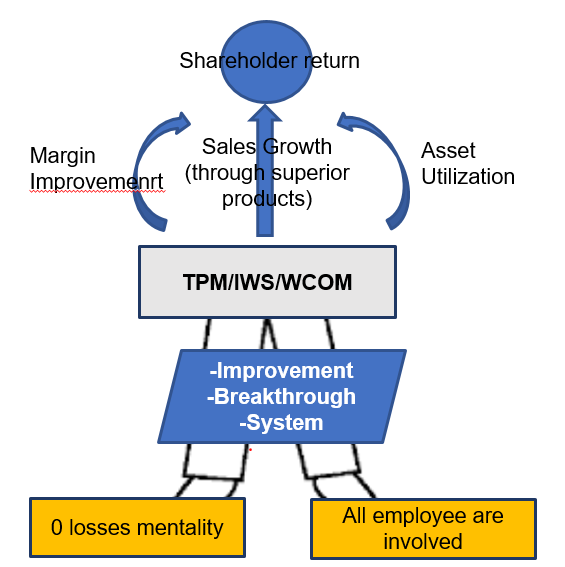
In TPM/IWS, this is achieved through three main levers: margin improvement, sales growth (where from operation contribution point of view is to make sure superior quality from competitor), and increased asset utilization (where OEE is often used as indicator).
So, where does AM fit into these goals?
As I wrote in my article on Restore Basic Conditions (RBC) (https://irvanpasaribu.com/2025/07/09/73/ ), many losses in a company block us from reaching these goals. AM is the pillar that ensures the basic conditions are established and sustained—especially at the shopfloor level.
I’ve written more about RBC in another article. There, I explained how the Japanese believe that restoring basic conditions can solve up to 80% of our problems. So, if that’s the case, why not start there?
AM plays a key role in making that possible. It gives the organization a stable baseline to improve from. Another key function of AM is increasing employee involvement. Its step-by-step approach ensures a large number of shopfloor employees are engaged in loss elimination.
Let’s break down those steps.
Step 1: Total Clean Out (TCO)
This starts with a deep cleaning, from the highest levels (even the Ops Director) down to operators. Why cleaning? Because as operators clean, they touch every part of the machine. They begin to care about the details and start noticing abnormalities—things like leaky O-rings, stuck bearings, hard-to-reach parts, and contamination sources.
The abnormalities are tagged and tracked. Teams plan how to resolve them (detagging). The number of detagged items becomes a measure of progress. Some companies use visible tagging paper to build urgency. No one wants to work in a machine full of flags—they push for quick resolution.
Before step 1, a good tagging system should already be in place (often referred to as step 0). This includes procedures for collecting and approving tags, setting priorities (sometimes using an ease/effect matrix), and involving the right people. Safety and spare parts must also be prepared beforehand.
Another outcome of step 1 is identifying contamination sources and hard-to-inspect areas. We don’t remove them yet—but we must list them. We also establish a temporary cleaning standard (provisional CILT), knowing the machine will get dirty again unless we tackle the root cause.
Step 2: Eliminate Sources of Contamination
This is not just removal—it’s eradication. For example, using “where-where” analysis to find repeated oil leaks may lead to a worn-out O-ring. A follow-up “why-why” analysis might show there’s no PM schedule for replacing it. The team then solves the root cause.
Step 3: Lubrication and CILT Standards
Here, operators learn about lubrication and map out responsibilities with maintenance. With contamination removed and inspections easier, it’s time to build fixed standards: CILT (Cleaning, Inspection, Lubrication, Tightening) in TPM, or CIL in IWS. This ensures consistency.
All these steps help operators become more sensitive to abnormalities. From the first deep clean—when leadership sets the example—through tagging, cleaning, and building standards, the shopfloor starts to care. They become part of the solution.
I remember a maintenance manager once said, “If the goal is to build CIL standards, why not just assign it?” He had already built a very detailed standard and divided the tasks between maintenance and operators. But he missed the point: pushing tasks is not the same as getting buy-in. You can’t force someone to care.
I’ve seen the same thing when working for the world’s largest packaging company. We thought that by giving clients a perfect maintenance manual and best practices—even from TPM award-winning factories—they could instantly become world-class. But they couldn’t. They lacked the step-by-step process to build operator capability and buy-in.
So, what’s the ultimate goal of AM in a company’s vision?
At its core, AM is about driving a cultural shift—especially at the shopfloor level—by deeply involving employees in the care of their equipment and workplace. But real cultural change doesn’t happen without buy-in, and AM creates the conditions for that buy-in to take root and grow.
AM ensures that the fundamentals—what we call “basic conditions”—are not only restored but sustained. From a business perspective, this foundation is powerful: it addresses and eliminates a significant portion of operational losses, often cited as high as 80%. That’s a potential 80% gain if approached correctly.
AM is not just important. It’s crucial.